Some artists come to art through training. Others arrive through what the Greeks called anankē — the force that cannot be resisted. Lucio Carbeli F. B. belongs to the second category.
Of Chilean-Italian heritage and based in Santiago, Chile, Carbeli studied law and practiced for a few years. But a powerful inner calling remained, and he decided to listen to it. It was during a period of crisis that he decided to pick up his brushes and begin expressing himself through color. He also began contemplative and meditative practices, and all of this brought about an inner transformation that led him to express himself through painting. This transition is evident from his early abstract watercolors, where color and brushstroke reveal a subtle world imbued with a powerful expressive energy. In these works, his character as an artist begins to take shape: his most intense experiences transformed not into dramatic gestures, but into images, colors, and expression.
What emerges from that origin is not the narrative of a wound. It is its transmutation. The word is precise: transmutation, not healing. His paintings do not document pain — they exceed it, converting it into color, into light, into physical presence on paper or canvas.
The Cosmogony
During some years of artistic practice, almost a decade now, Carbeli has built a visual cosmogony: a personal system of world-creation where American abstract expressionism, European informalism, and the devotional imagery of his two cultural traditions — Italian Mediterranean and Chilean Latin American — converge into a language irreducible to any of those sources separately. He is an artist who knows the tradition of the abstraction like Rothko with the color fields, and who has absorbed the color of late Turner without quoting him, who operates within the tradition of art as direct spiritual experience without belonging to any school.
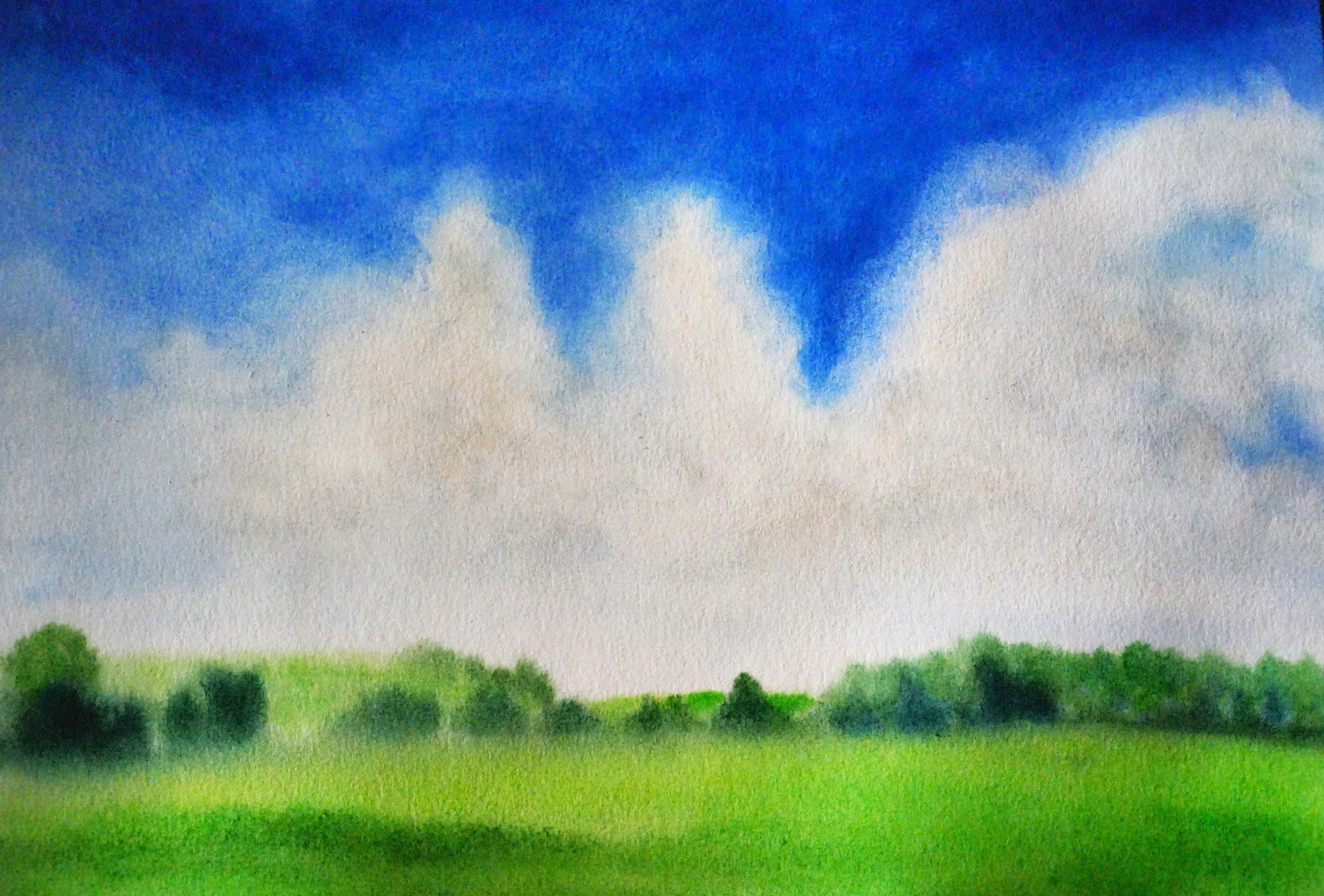
His primary medium is abstract watercolor, and that choice is not accidental: water carries the pigment, edges bleed into the undefined, no form fully fixes itself. Watercolor physically produces what Carbeli seeks philosophically: impermanence — the understanding that everything is subject to change, loss, and transformation. Not as tragedy, but as a condition of beauty.
The Chromatic Language
His palette is a system of correspondences that holds consistent across series and years. Red and crimson — present in The Powerful Traces of Love, Silence & Longing (60 × 76 cm, exhibited in Berlin), Red Beings (63 × 84 cm), and Interconnections: Heart, Minds & Cosmos — represent vital force, love in its most physical and inevitable sense. The blue-indigo of Interdependence (63 × 84 cm) or Heart Portal opens toward inner depth and the cosmic dimension. The yellow-orange of Seasons & Impermanence (63 × 84 cm) or Colors Expansion (84 × 63 cm) is pure energy, solar combustion. The violet of Reconnection with the Whole (84 × 63 cm) gestures toward transcendence.
The Series
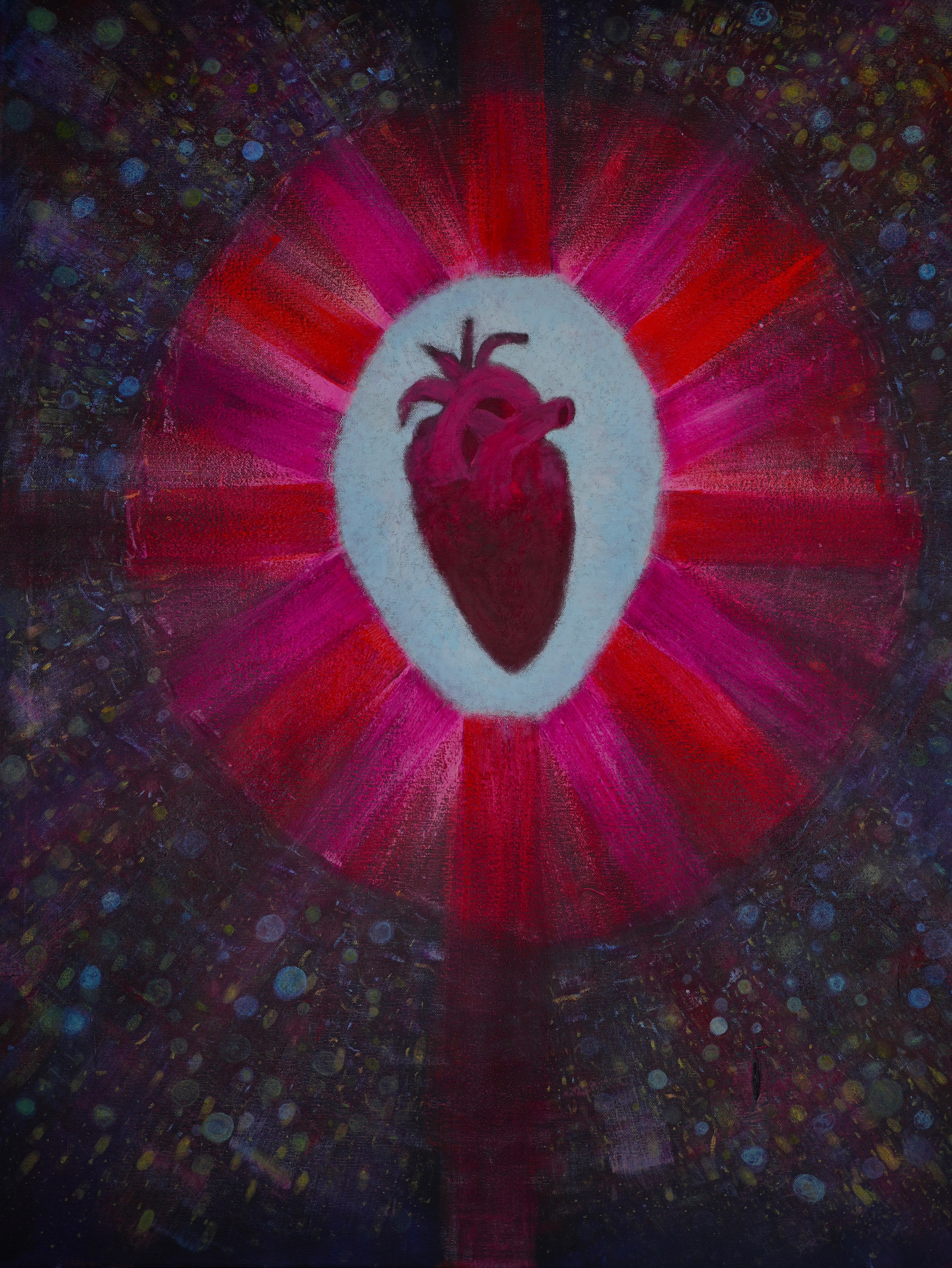
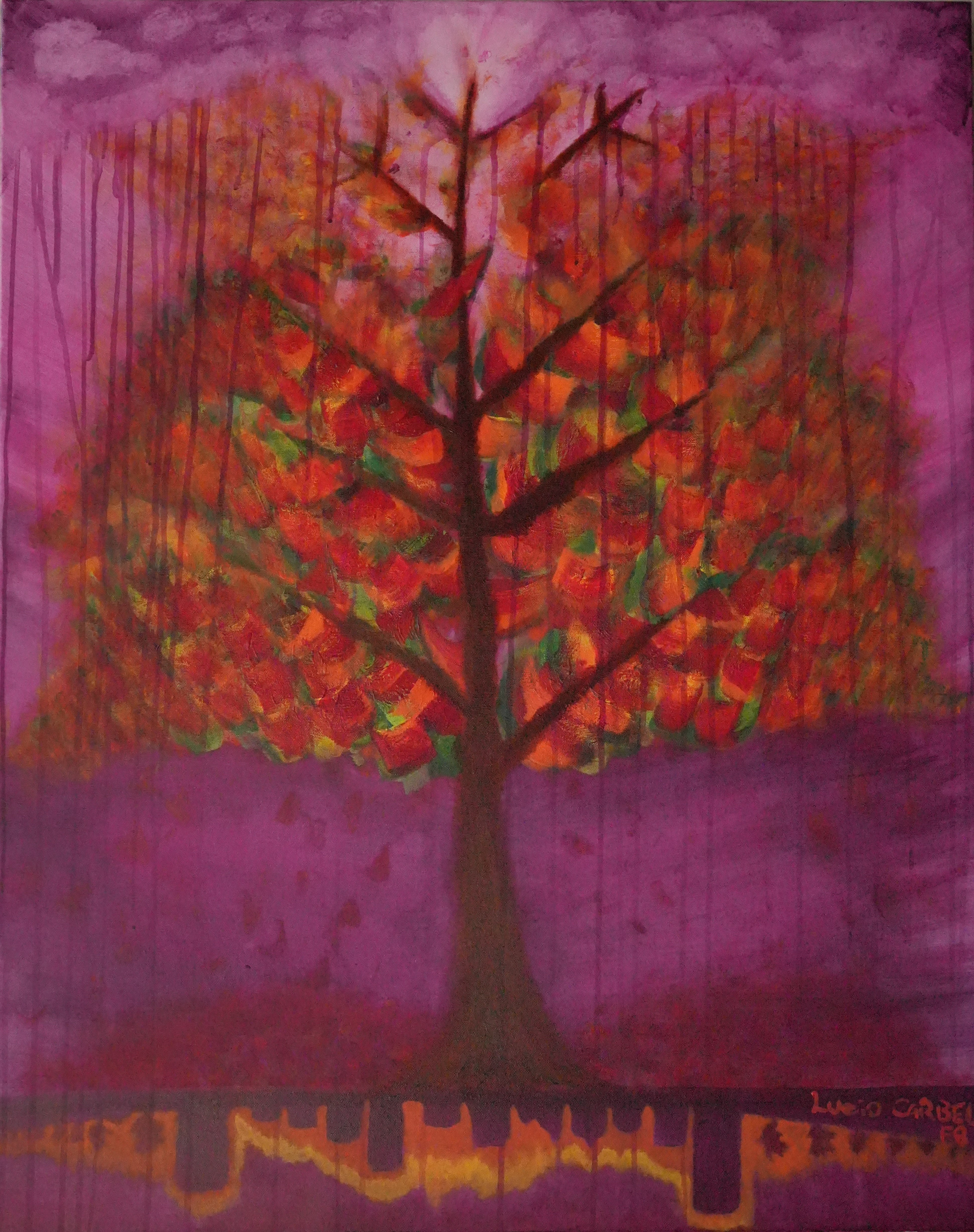
Carbeli’s practice articulates into at least four differentiated bodies of work. Pure abstraction — color fields where form emerges or dissolves without figurative anchor — coexists with the archetypal symbol: the tree, the heart, the landscape appear not as illustrations but as living archetypes. The tree of Our Life Is Out There (acrylic, 100 × 100 cm) is simultaneously nature, lung, and axis of the world; the anatomical heart of Inner Sacred Heart (acrylic, 80 × 100 cm) engages with the tradition of the ex-voto and the Sacred Heart of Latin American and Italian Catholic devotion, transmuted into a completely personal pictorial language. His largest work, INTER CORDIS (acrylic, 1.70 m × 1 m), carries that symbol to monumental scale: the heart as the world’s gravitational field.
A third, technically singular series explores watercolor with metallic interference pigments on black paper — the Ethereal Beings works (Ethereal Golden Energy, Alpha & Omega Portal, Sublime Ethereal Being). Here light does not come from the white paper but from the pigment itself: a technical inversion that corresponds to a philosophical one — the luminous emerges from darkness. In his own words, these ethereal beings are «the intelligence of the stars, what our culture calls angels: states of consciousness, like the wifi of our perception.»
A fourth, more recent register of growing social urgency — The Destruction of Life in These Times (acrylic, 100 × 100 cm), Show Us the Way to Love & Salvation (acrylic, 100 × 100 cm) — places his interior cosmogony in dialogue with the ecological and civilizational crisis of the present. Transcendence in Carbeli is not escapism: he looks inward and outward with the same intensity.
The Trajectory
His practice has evolved visibly from intimate watercolor toward monumental acrylic, from pure abstraction toward forms charged with explicit symbolism, from personal grief toward collective questioning. That movement is not figurative regression — it is expansion. His most recent works suggest an artist who has gained sufficient confidence in his language to risk the symbol without fear of illustration.
He has exhibited in Santiago, Rome, Milan, and Berlin, where in 2025 he presented The Powerful Traces of Love, Silence & Longing at Galería Azur Berlin’s group exhibition Session 8. Work held in private collections. Available on Artsy via Galería Azur Berlin. Featured in JL Interviews, Italian art and culture magazine (2025). He also develops cinematogrpahic prohects, like indie author cinematography in his digital channles, and develop digital cinematic ideas and starting to explore the ai in cinematic effects as an extension of his creative world.
He signs his work as Lucio Carbeli FB.
Website: luciocarbeli.com | Instagram: @luciocarbeli | Artsy: via Galería Azur Berlin
………..
Sobre Mí:
Hay artistas que llegan al arte por formación. Otros llegan por lo que los griegos llamaban anankē —la fuerza que no puede resistirse. Lucio Carbeli F. B. pertenece a esa fuerza.
De herencia chileno-italiana y radicado en Santiago de Chile, Carbeli estudió derecho y ejerció unos años en ese mundo. Pero un poderoso llamado interior seguí ahí, y él decidió escuchrlo. Fué en un período de crisis que decidió tomar los pinceles y comenzar a expresarse a través de los colores.Además comenzó a realizar prácticas contemplativas y meditativas, y todo eso realizó un cambio interior que lo llevó a expresarse mediante la pintura. Esa transición se muestra desde sus primeras acuarelas abstractas donde el color y el trazo muestran un mundo sutil y con una energía de gran expresión. En esas obras comienza a gestarse su carácter como artista: las experiencia más intensas convertidas no en gesto dramático, sino en imagen, en color, en expresión.
Lo que emerge de ese origen no es el relato de un cambio interior o de una crisis existencial; Es su transmutación. La palabra es precisa: transmutación, no sanación. Sus pinturas no documentan ese trance —lo exceden, convirtiéndolo en color, en luz, en presencia física sobre el papel o la tela.
La cosmogonía
A lo largo de algunos años, casi una década de práctica, ha construido una cosmogonía visual: un sistema propio de creación del mundo donde el expresionismo abstracto americano, el informalismo europeo y la iconografía devocional de sus dos tradiciones culturales —la mediterránea italiana y la latinoamericana chilena— convergen en un lenguaje irreductible a ninguna de esas fuentes por separado. Es un artista que conoce a las tradiciones abstractas como la de Rothko por su uso del campo de color, que ha absorbido el color del Turner tardío sin citarlo, que opera dentro de la tradición del arte como experiencia espiritual directa sin pertenecer a ninguna escuela.
Su medio principal es la acuarela abstracta, y esa elección no es casual: el agua lleva el pigmento, los bordes sangran hacia lo indefinido, ninguna forma se fija del todo. La acuarela produce físicamente aquello que Carbeli busca filosóficamente: la impermanencia —la comprensión de que todo está sujeto al cambio, a la pérdida, a la transformación. No como tragedia, sino como condición de la belleza.
El lenguaje cromático
Su paleta es un sistema de correspondencias que se mantiene coherente a través de series y años. El rojo y el carmesí —presentes en The Powerful Traces of Love, Silence & Longing (60 × 76 cm, exhibida en Berlín), Red Beings (63 × 84 cm) o Interconnections: Heart, Minds & Cosmos— representan la fuerza vital, el amor en su sentido más físico e inevitable. El azul-índigo de Interdependence (63 × 84 cm) o Heart Portal abre hacia la profundidad interior y la dimensión cósmica. El amarillo-naranja de Seasons & Impermanence (63 × 84 cm) o Colors Expansion (84 × 63 cm) es energía pura, combustión solar. El violeta de Reconnection with the Whole (84 × 63 cm) señala hacia la trascendencia.
Las series
La práctica de Carbeli se articula en al menos cuatro cuerpos de obra diferenciados. La abstracción pura —campos de color donde la forma emerge o se disuelve sin ancla figurativa— convive con el símbolo arquetípico: el árbol, el corazón, el paisaje aparecen no como ilustraciones sino como arquetipos vivos. El árbol de Our Life Is Out There (acrílico, 100 × 100 cm) es simultáneamente naturaleza, pulmón y eje del mundo; el corazón anatómico de Inner Sacred Heart (acrílico, 80 × 100 cm) dialoga con la tradición del ex-voto y el Sagrado Corazón de la devoción católica latinoamericana e italiana, pero transmutado en lenguaje pictórico completamente propio. Su obra de mayor escala, INTER CORDIS (acrílico, 1,70 m × 1 m), lleva ese símbolo a dimensión monumental: el corazón como campo de gravedad del mundo.
Una tercera línea —técnicamente singular— explora la acuarela con colores de interferencia metálica sobre papel negro, en la serie de los Ethereal Beings (Ethereal Golden Energy, Alpha & Omega Portal, Sublime Ethereal Being). Aquí la luz no viene del papel blanco sino del pigmento mismo: una inversión técnica que corresponde a una inversión filosófica —lo luminoso emerge de la oscuridad. En sus propias palabras, estos seres etéreos son «la inteligencia de las estrellas, lo que nuestra cultura llama ángeles: estados de conciencia, como el wifi de nuestra percepción».
Finalmente, un cuarto registro de creciente urgencia social —The Destruction of Life in These Times (acrílico, 100 × 100 cm), Show Us the Way to Love & Salvation (acrílico, 100 × 100 cm)— sitúa su cosmogonía interior en diálogo con la crisis ecológica y civilizatoria del presente. La trascendencia en Carbeli no es evasión: mira hacia adentro y hacia afuera con la misma intensidad.
El trayecto
Su práctica ha evolucionado visiblemente desde la acuarela intimista hacia el acrílico monumental, desde la abstracción pura hacia formas cargadas de simbolismo explícito, desde el duelo personal hacia la interrogación colectiva. Ese movimiento no es retroceso figurativo —es expansión. Las obras más recientes sugieren a un artista que ha ganado suficiente confianza en su lenguaje como para arriesgarse al símbolo sin temor a la ilustración.
Ha exhibido en Santiago de Chile, Roma, Milán y Berlín, donde en 2025 presentó The Powerful Traces of Love, Silence & Longing en la exposición colectiva Session 8 de Galería Azur Berlin. Su Obra también está en algunas colecciones privadas.
Actualmente algunas de sus obras están Disponibles en Artsy vía Galería Azur Berlin. Fue destacado por JL Interviews, revista italiana de arte y cultura (2025). Desarrolla también proyectos de cine independiente, como creación de cine de autor, cortos cinematográficos digitales y también buscando explorarlo con inteligencia artificial como extensión de su mundo creativo.
Firma su obra como Lucio Carbeli FB.
Sitio web: luciocarbeli.com | Instagram: @luciocarbeli | Artsy: vía Galería Azur Berlin